Maintenance Isn't Optional

After servicing 1,200+ AMC contracts and completing 2,500+ projects since 2007, I can tell you the pattern behind almost every fire safety failure: it wasn't a bad system. It was a maintenance gap nobody noticed until it was too late.
Why "it's working fine" is the most dangerous sentence in fire safety
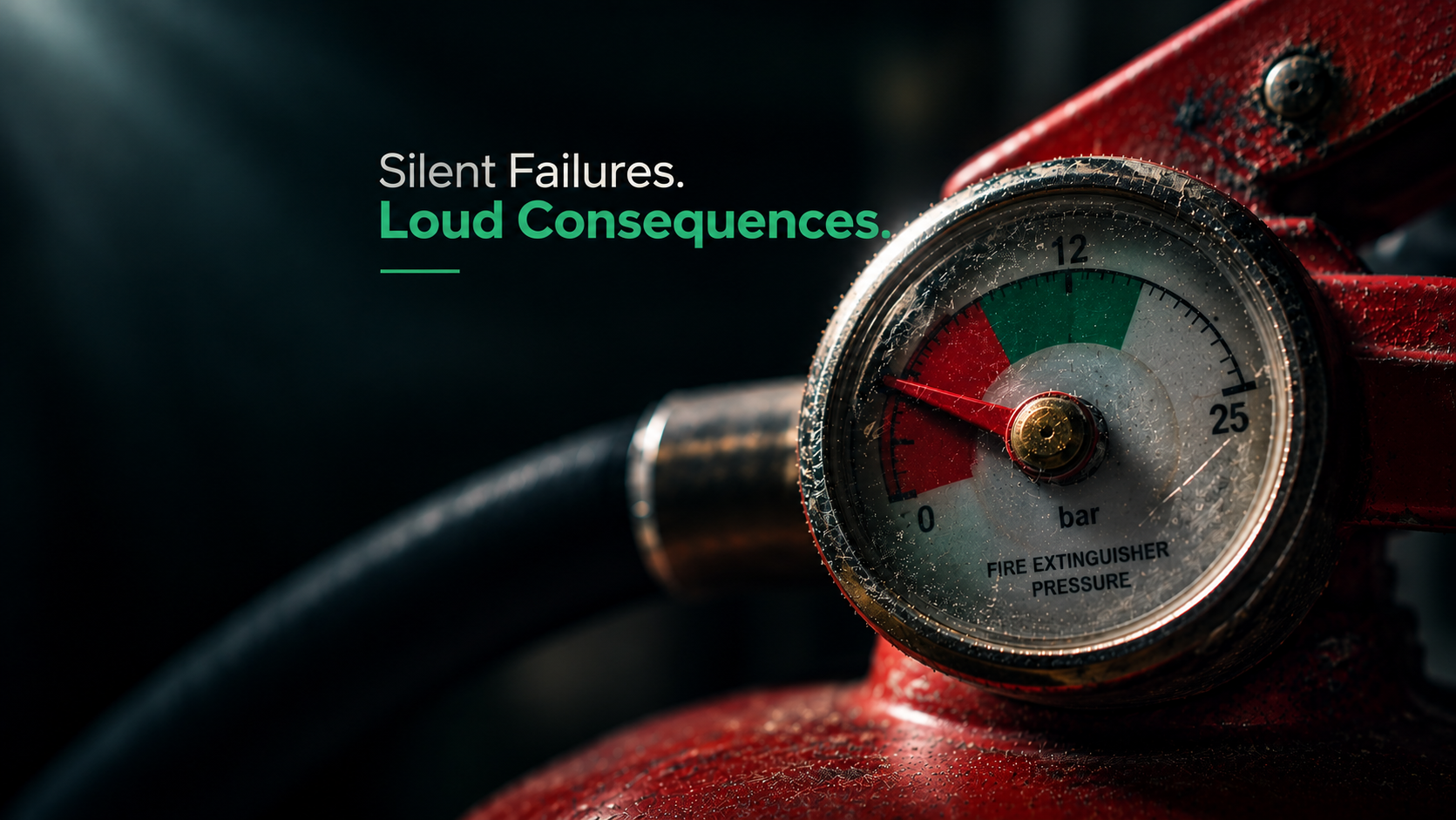
Fire systems don't send a warning before they fail. An extinguisher pressure gauge can sit in the "red zone" for months. A smoke detector's battery can silently die. A sprinkler valve can seize from corrosion no one inspected. A control panel can show a green "normal" light while three of its sensors have already gone offline. None of these show up on a walk-through. They only show up the one day the system is actually needed — and by then, it's not a maintenance issue anymore. It's an emergency with no backup.
This is the gap between a system that exists and a system that works. Most buildings have the first. Far fewer maintain the second.
A scenario we see more often than people think
A facility passes its annual fire safety audit. Paperwork is in order, extinguishers are mounted, alarms are installed. Eight months later, an electrical fault starts a small fire in a storage room. The nearest extinguisher hasn't been pressure-checked since installation — it's empty. The smoke detector above it has a dead battery, so the alarm never triggers in that zone. By the time it's noticed manually, what could have been contained in under a minute has spread through an entire floor.
Nothing about the original system was defective. Every failure point was something a routine inspection would have caught months earlier.
What routine maintenance actually catches
Across thousands of inspections, the same gaps show up again and again — not because equipment is poorly made, but because equipment degrades quietly over time, and nobody is watching unless someone is specifically assigned to watch:
- Blocked or obstructed fire exits and extinguisher access points
- Expired or under-pressurized extinguishers
- Faulty wiring or dead batteries in alarm and detection systems
- Corroded or leaking sprinkler valves and pipework
- Panels flagging "normal" while individual sensors have silently gone offline
- Fire doors that no longer close or seal properly due to worn hinges or hardware
- Signage and emergency lighting that has failed but goes unnoticed because it's rarely tested under real conditions
Each one is minor on its own. Together, they're how a fully "compliant" fire safety system fails exactly when it's tested for real.
Why annual checks alone aren't enough
Many facilities treat fire safety compliance as a once-a-year event: pass the audit, file the paperwork, move on. But equipment doesn't degrade on an annual schedule — batteries die whenever they die, valves corrode whenever conditions allow it, and pressure drops on its own timeline. A system inspected in January and left untouched until the next January has eleven months of unknown risk in between. Routine maintenance isn't about satisfying a compliance calendar. It's about closing that window continuously, not once a year.
What a proper AMC should actually include
Not all maintenance contracts are equal, and this is where many facilities unknowingly expose themselves. A serious AMC covers:
- Scheduled physical inspection of every extinguisher, alarm, panel, and sprinkler point — not just a paper checklist signed off from an office
- Functional testing of alarms and detection systems, not just a visual "it's mounted and looks fine" check
- Documented compliance reporting suitable for audits, insurance claims, and regulatory review
- Priority response for any fault found during inspection, not just a note logged for "next visit"
- Clear escalation paths when a critical fault is found, so it's fixed in days, not months
- Technicians trained on the specific systems installed, not generic servicing
If your current contract doesn't include most of these, it's likely a compliance formality rather than actual protection.
The real cost of skipping it
Skipping maintenance doesn't save money — it defers a bigger cost, and defers it onto the worst possible moment to discover it. Failed fire systems mean regulatory penalties for non-compliance, denied insurance claims when investigators find inadequately maintained equipment, and in the worst case, lives and property with no protection at the exact moment it mattered most. The math is simple: routine maintenance costs a fraction of what a single serious incident costs — in damage, downtime, liability, and reputation.
Every AMC contract we run exists for one reason: to make sure that gap between "installed" and "actually working" never opens in the first place.
The bottom line
A fire safety system is not a one-time investment — it's an ongoing responsibility. It's only as good as its last inspection, and the confidence a building owner feels because a system is "installed" is only real if it's been verified recently.
3,600+ clients trust us to make sure that inspection actually happened — properly, documented, and on time, every time. Not because we install fire safety equipment. Because we make sure it still works the day it's needed.