How Integrated Gas, Security and Safety Systems Are Changing Modern Buildings
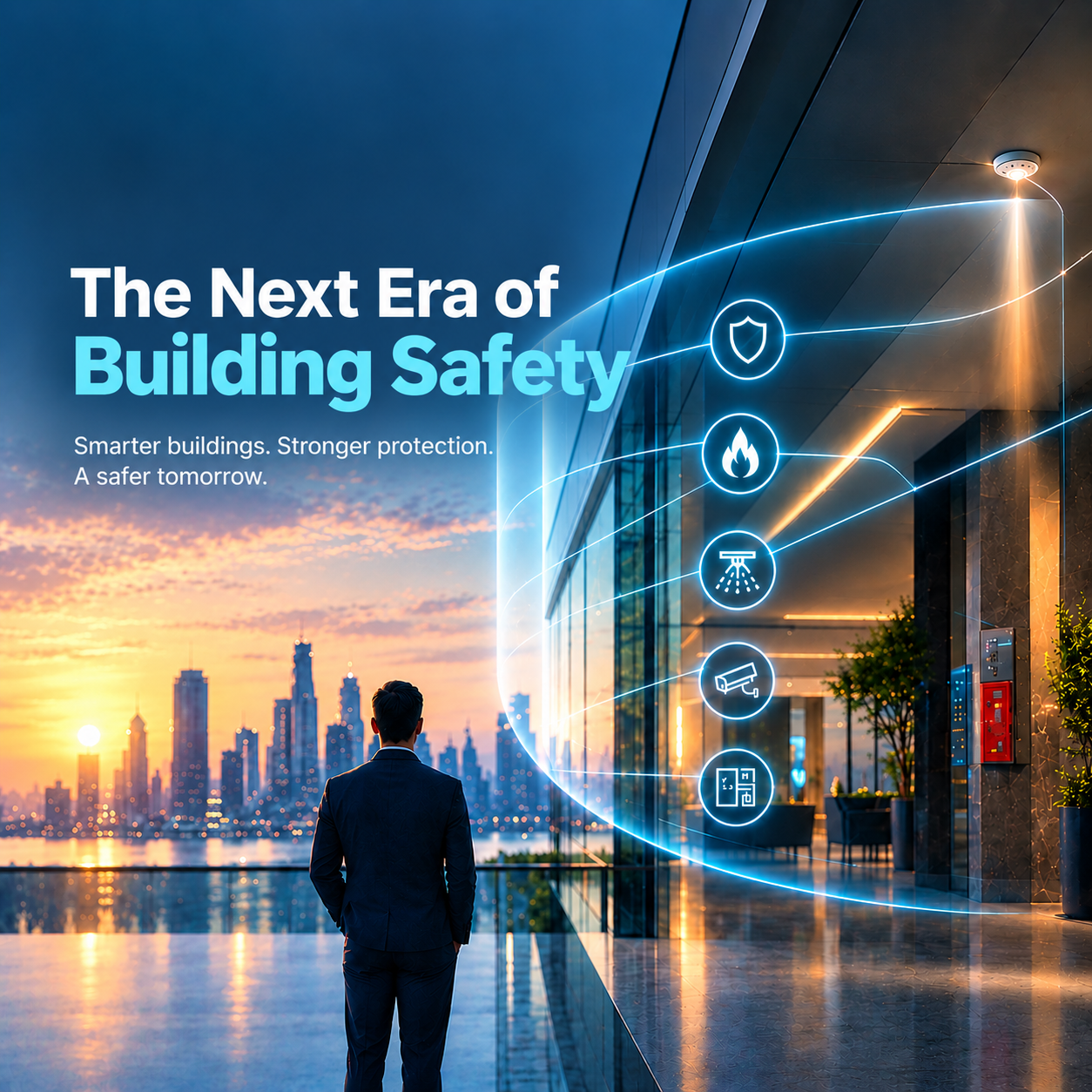
Modern buildings are no longer collections of isolated mechanical and electrical systems. They are increasingly becoming interconnected operational environments, where fire protection, security, gas detection, surveillance, access control, building automation and emergency response systems exchange information and contribute to a unified safety strategy.
This transition from standalone protection systems to integrated safety architecture is changing how commercial, industrial, hospitality, residential and mission-critical facilities are designed, operated and maintained.
The objective is not simply to install more safety equipment. It is to create a coordinated infrastructure capable of detecting abnormal conditions, correlating information, initiating predefined responses and supporting informed decision-making.
From Standalone Systems to Integrated Safety Architecture
Historically, fire alarms, CCTV, access control and building management systems were often designed as independent installations.
While each system could perform its intended function, limited interoperability meant that operators had to interpret information from multiple platforms.
Modern building automation is moving toward a different model.
Industry-standard communication frameworks such as BACnet are designed to facilitate interoperability between building systems and can support applications involving HVAC, access control, security and fire alarm monitoring.
This creates the foundation for a centralized and data-driven safety environment.
For example, an alarm generated by a fire detection system can become more operationally meaningful when the building's control infrastructure also provides information about the affected zone, access status, ventilation conditions and surveillance coverage.
The value comes from correlation, not simply connectivity.
The Convergence of Fire, Gas and Security Systems
A modern protection strategy increasingly considers multiple hazards simultaneously.
A facility may face risks from:
- Fire and smoke
- LPG or combustible gas leakage
- Unauthorized access
- Equipment failure
- Electrical abnormalities
- Industrial processes
- Security incidents
- Environmental conditions
These risks do not necessarily occur independently.
A gas leak, for instance, can become a fire or explosion hazard. An unauthorized entry into a critical plant area can create both a security and operational risk. An electrical fault may trigger a fire alarm while simultaneously affecting critical infrastructure.
Consequently, safety engineering is increasingly concerned with risk interdependency rather than individual hazards in isolation.
1. Fire & Life Safety as the Primary Protection Layer
Fire detection and life-safety systems remain fundamental to building protection.
However, their role within an integrated environment extends beyond simply activating an alarm.
Modern fire protection infrastructure can include:
- Addressable fire alarm systems
- Smoke, heat and multi-criteria detection
- Automatic sprinkler systems
- Clean-agent suppression
- Water-mist systems
- Fire pumps and hydrant infrastructure
- Emergency lighting
- Voice evacuation systems
- Fire-rated compartmentation
- Emergency communication systems
The important consideration is the cause-and-effect relationship between these systems.
A properly engineered system can define what should occur when a particular event is detected, subject to the approved design and applicable requirements.
This transforms an alarm from an isolated signal into part of a coordinated emergency response sequence.
2. Gas Detection and LPG Safety
Gas detection represents another critical layer, particularly in facilities where LPG, natural gas or other hazardous gases are present.
Modern gas detection systems can continuously monitor designated areas and identify potentially hazardous concentrations.
Depending on the application and engineering design, detection can interface with:
Gas detector → control panel → alarm → ventilation → gas isolation → emergency response
The exact sequence depends on the hazard analysis, equipment configuration and applicable requirements.
For industrial and commercial facilities, the integration of gas detection with other safety infrastructure can provide a more comprehensive approach to hazard containment and escalation prevention.
NFPA's building safety framework, for example, continues to address fuel-gas detection alongside other contemporary building safety considerations.
3. CCTV as an Intelligence Layer
CCTV is increasingly moving beyond conventional surveillance.
When incorporated into an integrated building environment, video systems can provide situational awareness during abnormal events.
Consider a fire alarm originating from a restricted plant room.
Instead of relying exclusively on an alarm notification, authorized operators may be able to correlate:
- The alarm location
- CCTV footage
- Access-control activity
- Building-system status
- Emergency communication
- Relevant environmental information
This creates a more comprehensive operational picture.
The distinction is important:
Detection tells you that something has happened.
Integrated information helps establish what is happening.
4. Access Control and Emergency Management
Access control is another important component of modern building security architecture.
Electronic access systems can regulate movement into sensitive areas such as:
- Server rooms
- Electrical rooms
- Plant rooms
- Control rooms
- Storage areas
- Restricted industrial zones
Integration with emergency systems can introduce event-driven control logic, allowing predefined responses to be implemented during specific emergency scenarios.
However, life-safety functions should remain governed by the approved fire and emergency strategy rather than treating security logic as a substitute for dedicated life-safety engineering.
The objective is to ensure that security and safety systems operate coherently without compromising emergency egress or other life-safety requirements.
5. The Role of Building Management Systems
The Building Management System (BMS) is increasingly becoming an important operational interface within complex facilities.
A BMS can provide centralized visibility across multiple building functions, including HVAC, energy management, equipment status and selected safety and security interfaces.
Open communication standards are particularly relevant because modern facilities frequently contain equipment from multiple manufacturers. BACnet, for example, was developed specifically to provide vendor-independent communication and interoperability across building automation applications.
This interoperability can reduce fragmented monitoring and provide facility teams with a more unified operational environment.
However, integration does not mean that every safety-critical function should be controlled through the BMS.
Critical fire and life-safety functions require appropriately engineered, listed and approved systems, with integration implemented according to the applicable design requirements.
6. Cybersecurity Becomes Part of Physical Safety
As buildings become digitally connected, cybersecurity becomes an increasingly important consideration in safety-system architecture.
A connected building creates additional communication pathways between devices, controllers, networks and management platforms.
This introduces questions such as:
- Who can access the system?
- How are devices authenticated?
- How is remote access controlled?
- Is communication encrypted?
- How are software updates managed?
- How are network segments protected?
- What happens if a communication network becomes unavailable?
BACnet International notes that increased integration and IP-based building automation create additional cybersecurity considerations. BACnet Secure Connect (BACnet/SC) provides encrypted communications and authentication mechanisms for BACnet environments.
Therefore, modern safety engineering increasingly needs to consider both physical resilience and digital resilience.
7. From Preventive Maintenance to Condition-Based Maintenance
Maintenance is another area undergoing significant transformation.
Traditional preventive maintenance generally operates according to predetermined schedules.
An increasingly data-driven approach can supplement scheduled maintenance with information such as:
- Equipment operating status
- Alarm history
- Fault patterns
- Detector condition
- Battery status
- Pump performance
- System events
- Communication failures
This can support a transition toward condition-based maintenance, where maintenance decisions are informed by the actual condition and performance of equipment.
For large facilities, this approach can improve asset visibility and help maintenance teams prioritize resources.
The objective is not merely to repair equipment after failure, but to identify degradation before it develops into operational or safety-critical failure.
8. Interoperability Is More Than Connecting Systems
One of the most important concepts in integrated building safety is interoperability.
Simply connecting two systems does not automatically make them interoperable.
True interoperability requires systems to exchange information in a predictable and meaningful manner.
This involves considerations such as:
- Communication protocols
- Data structures
- Device compatibility
- Alarm prioritization
- Cause-and-effect programming
- Cybersecurity
- System commissioning
- Documentation
- Testing and validation
BACnet's interoperability framework is specifically designed to allow equipment from different manufacturers to communicate through standardized data and command structures.
For building owners, this can also reduce dependence on proprietary ecosystems and provide greater flexibility over the operational lifecycle.
9. Commissioning Becomes Critical
The complexity of integrated systems creates another requirement that is sometimes underestimated: comprehensive commissioning.
A system may function correctly when tested individually but behave differently when multiple systems interact.
Integrated commissioning should therefore consider scenarios rather than individual devices alone.
For example:
Fire detected → alarm initiated → affected zone identified → required building responses activated → emergency notification initiated → relevant information presented to operators.
Each stage should be verified against the approved design and cause-and-effect matrix.
The objective is to demonstrate not only that individual components operate correctly, but that the complete safety sequence performs as intended.
The Future: A Unified Safety Ecosystem
The next generation of building safety will increasingly be defined by convergence.
Fire protection, gas detection, security, CCTV, access control, building automation, emergency communication and maintenance technologies will continue to become more interconnected.
But successful integration requires more than technology.
It requires:
Risk assessment + engineering + interoperability + cybersecurity + commissioning + maintenance
When these elements are considered together, safety systems can evolve from isolated pieces of equipment into a coordinated protection ecosystem.
Conclusion
The modern building is becoming a complex digital and physical environment. As this transformation continues, traditional standalone safety strategies are increasingly being complemented by integrated architectures capable of sharing information, coordinating responses and providing greater operational visibility.
For facility owners and managers, the strategic question is no longer simply:
“What safety systems do we have?”
It is:
“How effectively do our safety systems work together?”
The answer depends on engineering quality, system interoperability, cybersecurity, commissioning, maintenance and continuous evaluation of changing risks.
The future of building safety will not be defined by a single technology. It will be defined by how intelligently multiple protection layers are engineered to work together.