Beyond the Checklist: A Tiered Approach to Fire Safety Compliance Across Your UAE Property Portfolio
If you manage fire safety compliance for more than a handful of properties in the UAE, you already know the real challenge isn't a lack of solutions. It's deciding where to start.
A ten-tower residential portfolio in Abu Dhabi and a single retail unit in Sharjah don't face the same fire safety reality. Buildings differ in age, system condition, civil defence approval history, and how well documented their AMC and Istifa records are. Some sites have detailed maintenance logs going back years. Others have barely any record at all. Treating every building the same way—or trying to solve every building's problems at once—isn't practical, and it isn't necessary. This is where a tiered, portfolio-level approach makes a real difference.
Why fire safety compliance can't be one-size-fits-all
Every building in a portfolio carries its own mix of risk factors: age of the fire alarm and suppression systems, which civil defence authority governs it (ADCD, DCD, SCD, or SIRA), how recently it was inspected, and whether its Istifa certificate is current or lapsed. A strategy built around a single checklist applied uniformly across every property will always leave gaps—either over-servicing buildings that are already compliant, or under-prioritizing the ones with the most urgent risk. What a large portfolio actually needs is a structured way to sort buildings by readiness, then act accordingly.
Three phase of fire safety action
phase 1:Full system compliance projects
Full system compliance projects These are buildings requiring complete fire alarm or suppression system upgrades, major civil defence re-approval, or a full evacuation plan overhaul. They typically involve older buildings or properties that have never been formally assessed. This tier needs proper planning, capital budget, and coordination with the relevant civil defence authority—it's not a quick fix, but it delivers the most durable compliance outcome.
phase 2: Inspection and AMC-informed maintenance
For buildings already on an Annual Maintenance Contract with some inspection history, the priority shifts to targeted action—servicing specific components, addressing findings from the last inspection, and renewing Istifa certificates before expiry. This tier delivers near-term risk reduction without the scope of a full system overhaul.
phase 3: Baseline compliance for undocumented sites
Some buildings in a portfolio—newly acquired properties, or sites where records were lost or never properly maintained—have little to no compliance history available. Here, the priority is deploying essential, proven measures immediately: extinguisher placement, basic evacuation signage, and initial safety documentation, while a full audit is scheduled. Waiting for complete information before acting isn't an option when a building has no baseline protection in place.
In practice, most portfolios contain properties across all three tiers simultaneously—which is exactly why a single, uniform plan doesn't work.
From phases to a portfolio-wide framework
Recognizing which tier a building falls into is only the starting point. The real value comes from using that classification to prioritize action across an entire portfolio—sometimes dozens or hundreds of properties across multiple emirates. A practical framework needs to account for:- Regulatory deadlines—which Istifa certificates are approaching expiry, and under which authority (ADCD, DCD, SCD, SIRA)- Risk severity—system age, last inspection findings, and building occupancy type- Operational constraints—access windows, tenant disruption, and coordination with building management- Budget cycles—sequencing Tier 1 capital projects against Tier 2 and Tier 3 quick-turn work Rather than treating every property as an individual case requiring a fresh decision each time, this framework brings consistency to prioritization—while still leaving room for the judgment calls that every building inevitably requires.[H2] Why consistency matters more than perfection
Why consistency matters more than perfection
Portfolio owners and facility managers rarely need a granular breakdown of every building's fire safety status down to the last detail. What they need is a reliable way to compare risk across properties, understand where the most urgent gaps are, and make sequencing decisions with confidence—even when documentation is incomplete for some sites.
This is precisely why a tiered framework works better than chasing full audits everywhere before taking any action. It allows meaningful progress on Tier 3 buildings today, while Tier 1 projects are properly scoped and budgeted.
Applying this across the UAE
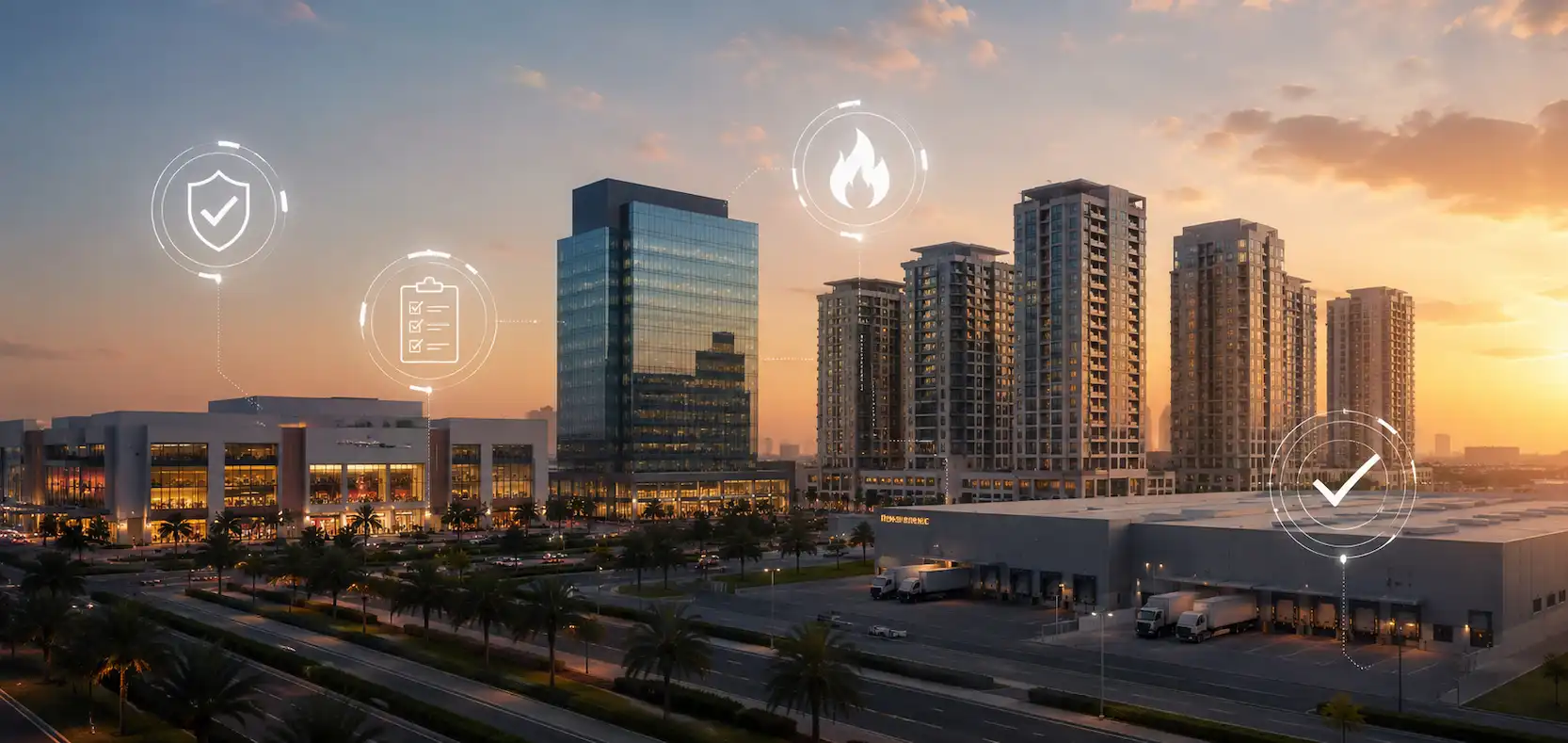
Firestone Fire and Security Systems has applied this kind of tiered, portfolio-level approach across commercial and residential properties spanning Abu Dhabi, Dubai, Sharjah, and Al Ain—working within the approval frameworks of ADCD, DCD, SCD, and SIRA. Property types range from residential towers and retail centers to logistics facilities and commercial offices, each with its own compliance history and risk profile. Managing fire safety compliance at scale isn't only a technical exercise—it's also a scheduling, documentation, and coordination challenge. A structured framework doesn't replace the judgment of an experienced fire safety team, but it does make that judgment repeatable across an entire portfolio. If you manage fire safety compliance across multiple properties and aren't sure where to start, a portfolio-level assessment is often the fastest way to see where the real priorities lie—before committing budget to any single building. Get in touch with Firestone Fire and Security Systems for a portfolio compliance review across your UAE properties.