
Fire Rated Sealant Suppliers & Applicators Serving Abu Dhabi, Dubai, Sharjah & Al Ain
CALL NOW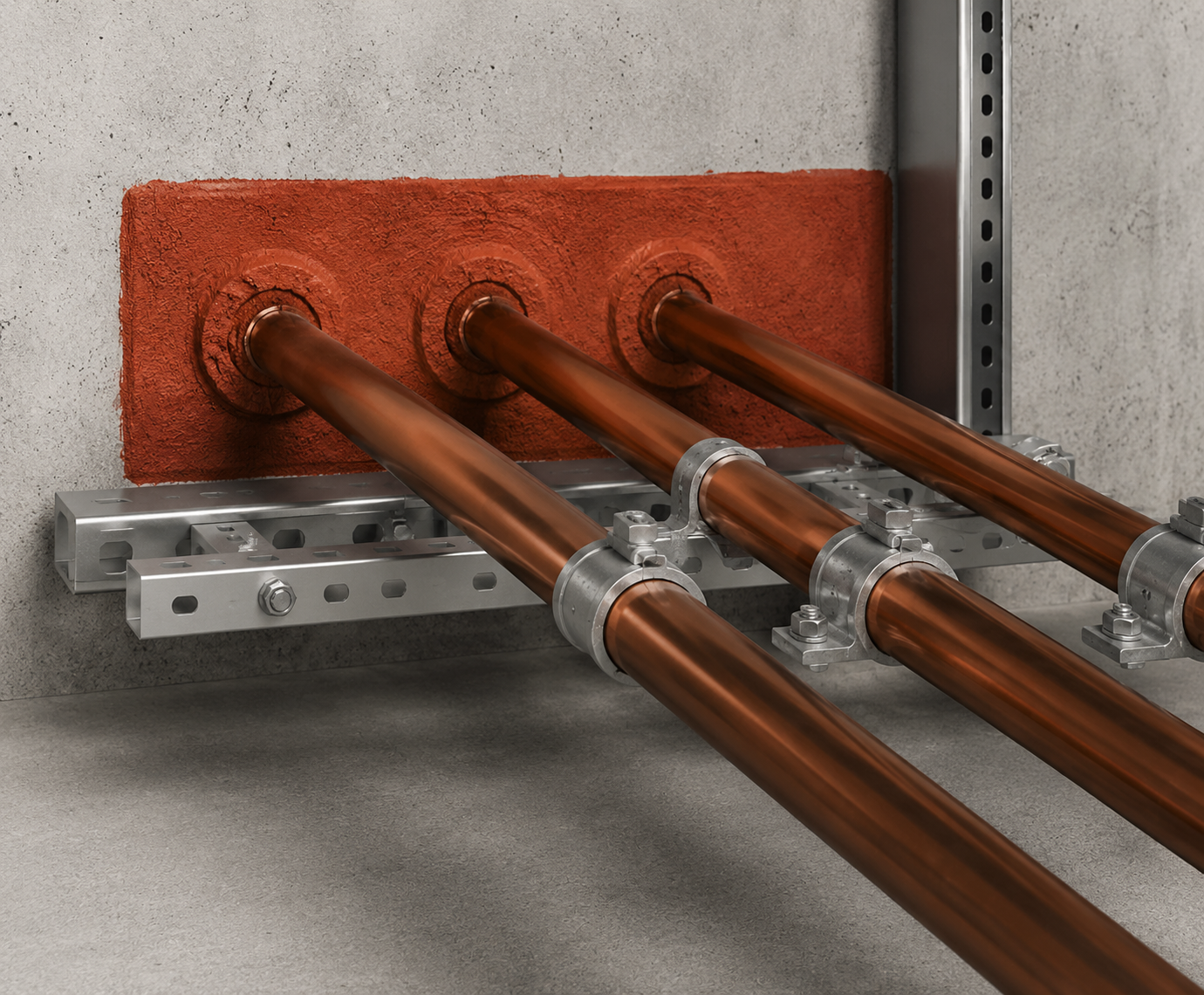
Fire rated sealant closes gaps around cables, pipes and joints in fire-rated walls and floors, holding back fire and smoke for the same duration the wall or floor is rated for. Every fire-rated wall or floor is only as good as its weakest point, and that weak point is almost always a penetration — a cable, a pipe, a joint — that wasn't sealed correctly.
We are fire sealant suppliers and applicators across Abu Dhabi, Dubai, Sharjah and Al Ain. We supply and install certified fire sealant matched to the specific penetration, gap width and fire rating your project requires, rather than a single sealant used for everything.
- Fire rated sealant for 30, 60, 90 and 120 minute ratings
- Hilti, Sika, Nullifire and Fischer products
- Category A civil defence approved
- Free quote after site survey
Fire sealant is a fire rated sealant formulated to expand, char, or cure in a way that blocks fire and smoke from passing through a gap or penetration in a fire-rated wall, floor, or ceiling. It is also called fire resistant sealant, fire barrier sealant or fireproof sealant, and when used as part of a fire stopping system it is known as fire stop sealant or firestop sealant. Unlike standard construction sealant, it's tested and certified to hold the seal under fire conditions for a specific duration, which is why using the correct fire sealant — not just any sealant that looks similar — is what actually protects the rating of the surrounding structure.
The distinction matters more than it might seem from the outside, because a standard sealant and a fire sealant can look nearly identical once applied — same bead, same finish, same color in some cases. The difference only shows up under fire conditions, when a standard sealant softens, melts, or burns away within minutes, leaving the exact gap it was meant to close now wide open to fire and smoke. A certified fire stopping sealant is formulated specifically to resist that failure, either by expanding to fill the growing gap as surrounding materials burn away, or by curing into a form that holds its shape and seal well past the point a standard product would have failed.
That's also why fire sealant is tested and rated to a specific duration — 30, 60, 90, or 120 minutes, matching the rating of the wall or floor it's sealing. A genuine fire resistant sealant has a defined, tested rating behind it, so always check the certificate rather than trusting a generic "fire resistant" label. Correct fire sealant application to the manufacturer's certified detail is what makes that rating hold on site, and it's what we deliver across the UAE.
Fire sealant work starts with identifying the exact penetration type, gap size, and the fire rating the surrounding structure needs to maintain, since the correct sealant and application method depends on all three. A cable bundle penetration, a single pipe, and a construction joint all call for different sealant behavior — expansion capacity, flexibility, gap-filling ability — so this assessment isn't a formality before the "real" work starts, it's what determines which product and technique actually get used.
Our trained fire sealant applicators carry out every installation to the manufacturer's certified detail — correct depth, correct surface preparation, correct curing time — because fire sealant applied incorrectly can fail to hold its rating even if the product itself was the right one for the job. Sealant applied over dust, moisture, or an unprimed surface may look fine on the day of installation but fail to bond properly, and that failure won't show up until it's tested under fire conditions. Depth and curing time are just as easy to get wrong under time pressure on a busy site, which is exactly why we work to the certified detail rather than judging it by eye.
Every fire sealant installation across the UAE is documented, so if a compliance audit or civil defence inspection asks which sealant was used and where, that record is already on file. The documentation covers the specific product, the penetration location, and the installation date. This matters for the life of the building too: if a renovation or fit-out disturbs a sealed penetration years later, a clear record of what was installed makes it far easier to reinstate the seal correctly rather than guessing at what's behind the wall.
The right fire barrier sealant depends on the penetration, the gap size and the fire rating required. We supply and apply three main types of fire rated sealant across the UAE.
Intumescent fire Sealant
Intumescent sealant expands significantly when exposed to heat, filling the gap around cables, pipes, or joints as it swells. An intumescent seal is well suited to penetrations where materials might shrink or burn away during a fire, leaving a larger opening than the original gap.
Fire rated silicone sealant
stays flexible after curing, making it a common choice for movement joints and penetrations that need to accommodate ongoing building movement without cracking the seal over time.
Fireproof foam sealant
Fireproof foam sealant is typically used for larger gaps or bulk penetrations, expanding to fill irregular openings around cable bundles, pipe clusters, or larger structural gaps where a bead of sealant alone wouldn't provide full coverage.
As fire sealant suppliers in the UAE, we supply and install fire rated sealant from recognized manufacturers including Hilti, Sika, Nullifire, and Fischer, specifying the correct product line for each project's penetration type and required fire rating. If your project's fire strategy or specification calls for a specific brand or system, we work to that exact spec rather than substituting an equivalent product.
Need a price for a specific fire sealant brand or product code? Send us the datasheet or BOQ and we'll quote it.

%20(1).webp)
.webp)
.webp)
Fire sealant is used wherever a penetration or joint passes through a fire-rated element: cable entries, cable tray penetrations, pipe penetrations, construction joints and gaps around ductwork. Each one needs a different sealing approach, from a simple pipe seal to a joint that must move with the building.
Cable entry is one of the most common fire sealant applications. Cable bundles are rarely a uniform shape, so fire sealing around cables often uses fire rated sealant and pillow systems that mould around irregular shapes and still hold the required fire rating.
We carry out fire sealant application across Abu Dhabi, Dubai, Sharjah and Al Ain. Tell us the penetration type and fire rating you need, and we'll install the right fire stop sealant.
We deliver certified Fire and security systems tailored to your facility’s needs.