
.webp)
Emergency lighting keeps escape routes visible and safe to use if a building loses power during a fire or other emergency, guiding occupants to exits when normal lighting fails. Firestone Fire and Security Systems designs, installs, and maintains emergency lighting and exit sign systems across commercial, residential, and industrial buildings in the UAE, integrated with fire alarm and central battery systems.
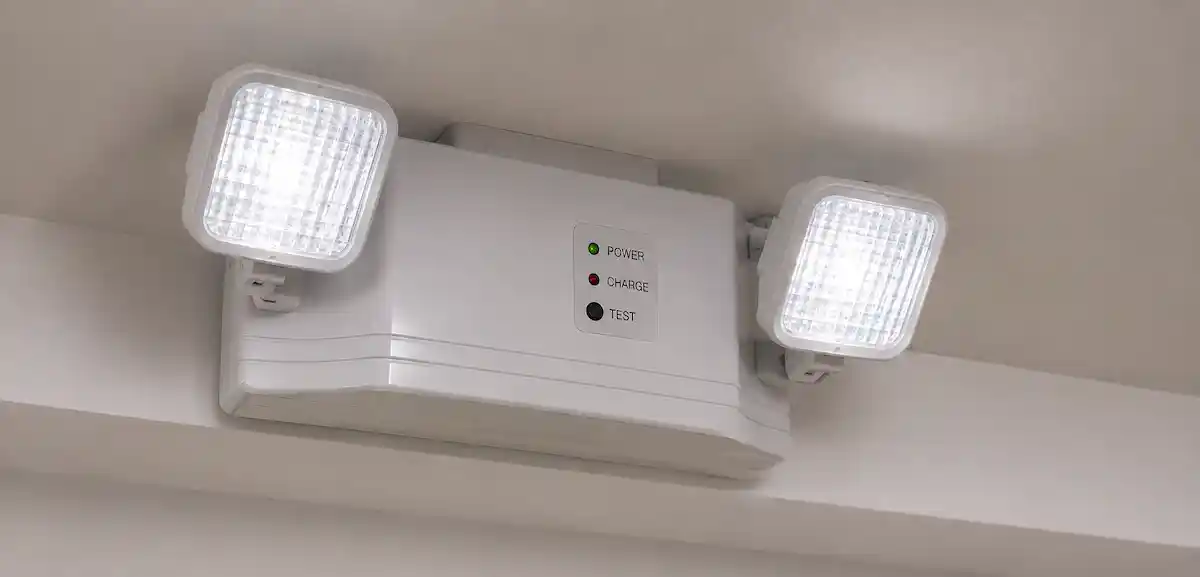
Emergency lighting activates automatically the moment normal mains power is lost, switching to a backup power source to keep escape routes, stairwells, and exit points illuminated long enough for safe evacuation. Depending on the building, that backup power comes either from a battery built into each individual light fitting, known as self-contained emergency lighting, or from a central battery system feeding multiple fittings across the building through a dedicated supply. Exit signs work alongside this lighting, staying illuminated or backlit to direct occupants toward the nearest safe exit even in low visibility.
Self-contained emergency lighting has its own battery built into each fitting, making it simpler to install since no dedicated central wiring is needed, though each unit needs to be tested and its battery replaced individually over time.
Central battery emergency lighting draws backup power from one central battery system feeding multiple fittings through the building, simplifying testing and maintenance since the system can be monitored and tested from a single point rather than fitting by fitting.
The right choice depends on the building's size, layout, and how the fire alarm and life safety systems are already structured, which our team assesses during design.
Exit signs are positioned to give occupants a clear, continuous path toward the nearest safe exit from any point in the building, remaining visible whether lit internally or externally illuminated by nearby emergency lighting. Sign placement is planned alongside the emergency lighting layout so escape routes are never left with a gap in visibility or direction.
Routine maintenance includes testing each fitting's battery backup function, confirming light output meets the level required along escape routes, and checking exit signs remain clearly visible and correctly illuminated. Central battery systems are tested from the control panel, while self-contained fittings are tested individually, with all results documented to support civil defence inspection and Istifa records.
Emergency lighting is required along escape routes, stairwells, corridors, car parks, and at final exit points in virtually every commercial, residential, and industrial building, assessed by civil defence as part of the overall fire and life safety design. Buildings with complex layouts, basement car parks, or areas without natural light typically need more extensive coverage to keep every part of the escape route visible.
We deliver certified Fire and security systems tailored to your facility’s needs.